Matti Hämäläinen
Development Manager
City of Riihimäki


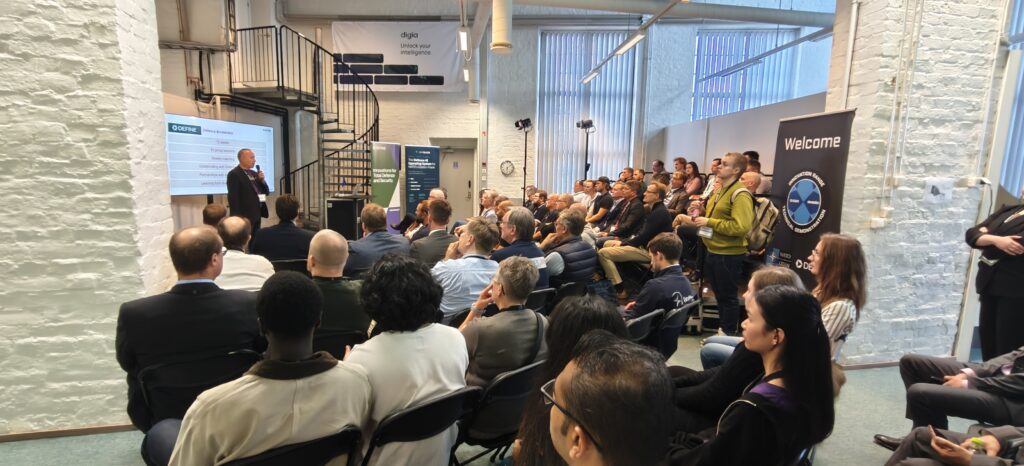
On Wednesday, 2 September 2026, the fifth batch of the DEFINE Accelerator officially kicked off at DEFINE Innovation Hub in Riihimäki. Once again, 12 new companies joined the accelerator, bringing with them fresh ideas, innovative solutions and new perspectives to the defence and security sector. The Kick-Off event gave the companies an opportunity to introduce their solutions to their mentors and to the public, and take a jump start to their three-month accelerator journey together with the DEFINE community.
One of the highlights of the day was the Speed Dating session, where the new DEFINE trainees and the participating accelerator companies had the opportunity to meet, exchange ideas and get to know each other. The session was a great way to start building connections and exploring potential collaboration opportunities from the very beginning of the programme.
With a new group of ambitious companies, enthusiastic trainees and a strong community around them, DEFINE Accelerator Batch 5 is now officially underway.
Learn more about the new accelerator companies here:
APL Systems, Finland
APL Systems has over 15 years of experience in acoustic monitoring, signal analysis and predictive condition monitoring, having delivered 300+ projects and collected over 1.2 million hours of acoustic data across industrial and infrastructure sectors. It is now applying this expertise to defence, using acoustics, traffic calculation and target-based classification algorithms to detect, identify and classify vehicles for situational awareness and infrastructure protection. The system is designed to be deployed in both ground-based and airborne applications, creating a scalable dual-use platform.
Aranis, Lithuania
Aranis is a deeptech dual-use defence technology company developing an AI-enabled augmented reality platform for tactical situational awareness. The platform combines live video, sensor data, computer vision and AR into a shared, real-time operational picture for field operators. Its initial focus is on area security and critical infrastructure protection.
Aurora Sentinel, Finland
Aurora Sentinel is a defense technology company providing “Software-Defined Defense” for modern warfare, with its flagship platform fusing multi-spectral sensors with real-time AI to solve incomplete situational awareness caused by smoke, glass and camouflage. Its immediate focus is the UAV and drone payload segment, the fastest-growing area in tactical imaging. Through a modular hardware architecture and a high-margin SaaS model, it provides scalable intelligence libraries that ensure long-term mission relevance.
Cobra Medical, Finland
Cobra Medical is a defense tech startup developing automated first-aid tools for critical conditions. Its innovation is a fully automated tourniquet with a patent-pending tightening mechanism. The company operates in the global dual-use market, with primary target segments including defense forces, police and first responders.
EXALOCUS, Finland
EXALOCUS originally developed a high-accuracy outdoor positioning solution for markets such as airports, container harbours, railways and logistics. It has since added AI to build a drone detection solution that identifies drone position, speed, type and brand with high update-rate precision. The underlying method is widely patented.
Gridence, Finland
Gridence develops a dual-use situational awareness and decision-support platform for low-altitude airspace monitoring, aimed at environments where civilian and defence activity increasingly overlap. Its core product is a map-based, EU-hosted SaaS platform that fuses data from multiple sensors into a single, real-time, sensor-agnostic operational picture, with AI under development to baseline normal activity and flag anomalies like unauthorised drones. The platform targets airports, cities, critical infrastructure and controlled airspace zones, and is deployable now on existing EU sensor networks rather than years away.
Kasper Defence, Finland
Kasper Defence develops low-cost, cellphone-powered decoys for battlefield deception. The system uses distributed field units that can be remotely activated to create detectable signal and activity, making an adversary perceive false targets. Its goal is to provide an affordable and scalable way to support deception operations and study adversary behaviour.
NaturAI, Finland
NaturAI is a NatureTech startup that specializes in automating environmental monitoring through ecoacoustics and artificial intelligence. Its AI model can be trained to recognize a variety of sounds from the field. The existing model is based on nature sounds and species detection, but the same technology is applicable to human-caused sounds as well, such as drones.
Sensepilot, Lithuania
SensePilot is a dual-use software company developing human-robot interaction technology, having started with an accessibility app enabling computer control through head and facial tracking. It is now adapting this into an HRI module combining controller input with head-tracking control for cameras, gimbals, sensors, turrets and robotic actuators, helping operators control unmanned systems more intuitively. The company is looking to validate the technology with defence users and robot integrators in real operational scenarios.
SpectraWatch, Sweden
SpectraWatch is a security tech company delivering real-time detection and identification of unauthorized drones and their operators. Its passive RF sensor identifies threats the moment a drone powers on, locating both the aircraft and its operator at range. The company has live deployments serving ports, airports, critical infrastructure and construction sites.
Tectum Aero, Germany
Tectum Aero expands missile defense capacity for armed forces by building a distributed, low-cost terminal interception layer against ballistic missile threats, addressing the structural scarcity and cost of legacy interceptor capacity. Its software-defined, distributed architecture enables scalable terminal defense close to the protected asset at a fraction of legacy deployment and interception cost.
Tethys Robotics, Switzerland
Tethys Robotics develops a compact underwater robot for autonomous underwater search, inspection and intervention in currents, low visibility and confined environments. It supports area coverage and clearance by autonomously scanning zones, detecting objects of interest, and enabling remote inspection before divers are exposed, and can also carry EOD payloads to prepare mine-like objects for neutralisation from a safe distance. This makes it relevant for mine-countermeasure support, EOD operations, harbour security, and critical underwater infrastructure protection.
Development Manager
City of Riihimäki
Category archive: Events